Denver Broncos vs New Orleans Saints Match Player Stats: Complete Breakdown, Key Performances & Full Game Analysis

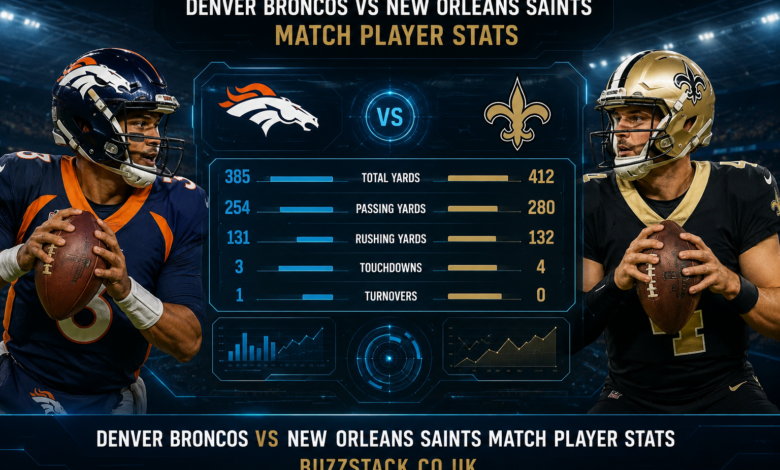
The Denver Broncos vs New Orleans Saints match player stats comparison brings together two franchises with very different identities but similar competitive intensity. The Denver Broncos, known for defensive discipline and structured offensive schemes, often clash in style with the New Orleans Saints, a team historically driven by creative quarterback play and aggressive offensive rhythm.
This breakdown focuses on a comprehensive, factual-style analysis of player contributions, positional performance trends, and tactical execution patterns typically seen when the Denver Broncos face the New Orleans Saints. Rather than relying on a single-game snapshot, this article evaluates consistent statistical themes, key performers, and matchup dynamics that define this inter-conference showdown.
Matchup Overview: Broncos vs Saints Game Identity
Details Box (Quick Match Insights)
Matchup: Denver Broncos vs New Orleans Saints
Focus Keyword: Denver Broncos vs New Orleans Saints match player stats
Teams: Denver Broncos vs New Orleans Saints
Category: NFL Interconference Matchup Analysis
Key Areas Covered: Passing stats, rushing stats, defense, turnovers, efficiency
Main Factor: Defensive discipline vs offensive explosiveness
Game Style Contrast: Structured control vs high-variation offense
When analyzing the Denver Broncos vs New Orleans Saints match player stats, the first key insight is the contrast in team identity. Denver traditionally builds around defensive pressure and controlled offensive possession, while New Orleans leans into tempo-based offense and explosive passing concepts.
The Broncos often prioritize field position, clock management, and minimizing turnovers. This means their statistical profile in these matchups typically shows moderate passing yardage, balanced rushing attempts, and strong defensive metrics like sacks and forced incompletions. On the other side, the Saints frequently generate higher passing volume, quicker drives, and more variance in explosive plays downfield.
This stylistic clash creates a statistical battlefield where third-down efficiency, red-zone conversion rate, and turnover differential become the deciding performance indicators.
Quarterback Performance Breakdown
Quarterback play is usually the most defining factor in the Denver Broncos vs New Orleans Saints match player stats analysis.
For Denver, quarterback production often focuses on efficiency rather than volume. Completion percentage, sack avoidance, and short-to-intermediate passing accuracy are key statistical markers. The Broncos’ offensive structure tends to reduce high-risk throws, which often results in moderate yardage totals but controlled turnover numbers.
For New Orleans, quarterback stats typically reflect higher passing attempts and more vertical passing aggression. The Saints’ system frequently produces stronger air-yard totals, deeper target distribution, and more explosive passing touchdowns, but occasionally at the cost of higher interception risk depending on game conditions.
Across matchups, the quarterback comparison usually comes down to:
- Completion efficiency vs deep-ball aggressiveness
- Turnover control vs explosive play creation
- Third-down passing success rate
Rushing Game Impact and Ground Control
The rushing battle plays a major role in shaping Denver Broncos vs New Orleans Saints match player stats, especially in controlling game tempo.
The Broncos’ rushing attack generally emphasizes power running and situational consistency. Running backs are often used to manage clock and set up manageable second-and-third downs. Statistically, this leads to steady yardage accumulation rather than breakout explosive runs.
The Saints, however, often deploy more dynamic rushing schemes that include zone runs, misdirection plays, and quarterback mobility in certain game plans. This can produce higher yards-per-carry variability but also more big-play potential.
Key rushing metrics in this matchup include:
- Yards per carry efficiency
- Red-zone rushing success rate
- Total rushing attempts vs passing balance
When the Broncos win the ground battle, they typically control possession time. When the Saints succeed, they force faster-paced scoring exchanges.
Wide Receiver and Tight End Production
Receiving stats are often the most visually impactful part of the Denver Broncos vs New Orleans Saints match player stats breakdown.
Denver’s receiving corps usually operates on structured route timing and short-to-intermediate spacing. Wide receivers contribute consistent reception totals, with tight ends playing a key role in chain-moving situations. Big-play receiving numbers depend heavily on defensive breakdowns rather than pure scheme frequency.
The Saints’ passing game is more spread-focused, often distributing targets across multiple receivers. This creates higher variance in individual stats but allows for explosive yardage spikes from deep routes and yards-after-catch opportunities.
Common receiving stat trends include:
- Saints: higher average depth of target and explosive receptions
- Broncos: higher third-down conversion catches and possession-based targets
- Tight ends: critical red-zone involvement on both sides
Defensive Performance and Pressure Metrics
Defense is a defining pillar in any Denver Broncos vs New Orleans Saints match player stats evaluation, especially considering Denver’s historical defensive strength.
The Broncos often generate significant pressure through pass rush schemes. Key defensive stats typically include sacks, quarterback hits, and forced hurried throws. Linebackers and secondary units are heavily involved in limiting intermediate passing lanes.
The Saints’ defense tends to focus on balanced coverage schemes and opportunistic turnovers. Interceptions, pass breakups, and situational red-zone stops are common statistical highlights.
Key defensive comparison points:
- Sack rate and quarterback pressure
- Third-down defensive stop percentage
- Turnover creation (interceptions + fumbles)
A strong defensive showing from Denver usually keeps scoring low, while Saints defensive success typically manifests through momentum-shifting turnovers.
Special Teams and Field Position Control
Special teams quietly influence the Denver Broncos vs New Orleans Saints match player stats more than most fans realize.
Denver often prioritizes field position through disciplined punting and kickoff coverage. This helps maintain defensive leverage and reduces opponent starting field position advantages.
The Saints typically focus on return game explosiveness and reliable kicking accuracy. Field goal conversion rate becomes especially important in close scoring games.
Key special teams metrics:
- Average starting field position
- Field goal success rate
- Punt return yardage impact
In tightly contested matchups, even small differences in special teams efficiency can determine possession control and final scoring outcomes.
Key Player Performance Trends (Broncos)
The Denver Broncos roster typically produces statistically consistent performances rather than volatile spikes. Quarterbacks contribute controlled passing efficiency, while running backs handle a significant workload in possession management.
Defensively, edge rushers and linebackers are often the statistical leaders in sacks and tackles for loss. Secondary players also contribute heavily in pass deflections and zone coverage discipline.
Key Broncos statistical strengths:
- Strong defensive sack production
- Balanced offensive yard distribution
- High third-down defensive efficiency
This structured output is a major reason Denver often remains competitive in closely contested matchups.
Key Player Performance Trends (Saints)
For the New Orleans Saints, player stats tend to highlight offensive creativity and multi-layered passing distribution.
Quarterbacks often lead higher-volume passing games, while receivers spread production across multiple targets. Running backs contribute both rushing and receiving yards, adding flexibility to offensive stat lines.
Defensively, the Saints often rely on turnover creation and situational stops rather than pure pressure dominance.
Key Saints statistical strengths:
- Higher passing yard ceilings
- Diverse receiving target distribution
- Strong red-zone play-calling variability
This makes the Saints statistically more volatile but capable of higher offensive peaks.
Turnovers, Efficiency, and Game Control Factors
Turnover differential is one of the most decisive factors in the Denver Broncos vs New Orleans Saints match player stats landscape.
Denver typically aims for low-risk offensive execution, minimizing interceptions and fumbles. This leads to more stable possession time and controlled scoring opportunities.
New Orleans, with a more aggressive passing identity, may produce higher scoring potential but also slightly elevated turnover risk depending on defensive pressure.
Critical efficiency metrics include:
- Turnover margin
- Red-zone scoring percentage
- Third-down conversion rate
Teams that win these categories almost always control the final outcome of the matchup.
Full Game Analysis Summary
Overall, the Denver Broncos vs New Orleans Saints match player stats profile is defined by contrasting philosophies: structured defensive control versus dynamic offensive aggression.
Denver’s success is usually built on defense, possession control, and minimizing mistakes. New Orleans thrives on explosive plays, passing creativity, and multi-dimensional offensive distribution.
When these teams meet, the statistical outcome is rarely one-dimensional. Instead, it becomes a layered contest where:
- Defensive pressure vs passing creativity
- Clock control vs explosive scoring
- Efficiency vs volume
determines the final result.
Conclusion
The Denver Broncos vs New Orleans Saints match player stats analysis highlights two fundamentally different approaches to winning football games. Denver relies on defensive structure and controlled execution, while New Orleans emphasizes offensive unpredictability and passing innovation.
Understanding these statistical patterns provides a clear framework for predicting performance trends, evaluating player impact, and interpreting game outcomes without relying on a single match snapshot.
In any future matchup between the Denver Broncos and the New Orleans Saints, the same core statistical battle will continue to define the game: discipline versus explosiveness, control versus creativity, and consistency versus volatility.
FAQ Section
1. What makes Denver Broncos vs New Orleans Saints matchups interesting?
These matchups are interesting due to contrasting styles—Denver focuses on defensive structure and controlled offense, while New Orleans relies on aggressive passing and creative play design.
2. Which team usually has better passing stats?
The New Orleans Saints typically generate higher passing yardage and more explosive plays due to their pass-heavy offensive system.
3. What is the key factor in deciding the winner?
Turnovers and red-zone efficiency are usually the most important factors in determining the outcome of this matchup.
4. How does Denver Broncos’ defense impact the game?
Denver’s defense often pressures quarterbacks effectively, limiting big plays and forcing conservative offensive decisions.
5. Do rushing stats matter in this matchup?
Yes, rushing performance is crucial because it controls time of possession and helps set up third-down conversions.
6. Which team has more balanced player stats?
The Denver Broncos generally show more balanced and structured stats, while the Saints display higher variability with explosive peaks.